Introduction
Early childhood education is the most crucial phase of a child’s development. Many years ago Dr. Maria Montessori worked on various methods of learning and discovered a unique method of learning i.e. Montessori approach. It focuses on improving motor and sensory skills which results in independence, curiosity and self directed learning. This philosophy of learning brings up the importance of basic life skills in order to improve physical, cognitive, social, and emotional growth. This is completely based on exercises allowing children to explore their environment and refine their senses giving them a strong foundation for formal education. Dr. Maria believed that learning basic life skills in realistic and relatable surroundings is the foremost stage of a child’s learning. When it comes to cognitive growth, the Montessori approach lays tension on exploration of a child’s potential through simple and mindful activities where the child analyses his own mistake and fixes it according to his understanding.
Motor Skills
Motor skill refers to the ability which includes the physical movement, strengthening the muscles, playing a vital role in early childhood education. It’s of two types – ‘fine motor’ and ‘gross motor’ skills. Fine motor refers to the ability such as grasping, writing, holding things etc., whereas gross motor refers to the movements like walking, jumping which is equally important for a child’s development. A child with well developed fine motor control finds it easier to hold a pencil, cut with scissors, or fix small objects. Strong motor skills often help children maintain balance, coordinate movement and participate confidently.
Fine Motor Skills include:
- Playdough fun – Rolling, squishing, and shaping dough enhances finger strength.
- Drawing and coloring – Not only it inculcates creativity but also brings imagination to the child.
- Puzzle solving – It strengthens problem-solving, decision making and finger dexterity.
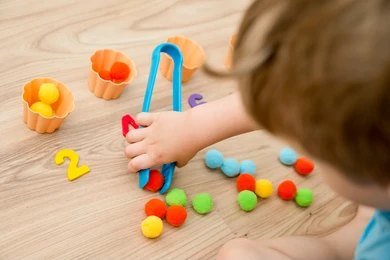
- Sorting Coin or Beads – Shuffling and sorting coins or beads can fortify hand and eye cordination.
- Origami – Here, the child folds the paper and make patterns which improve his hand dexterity and creativity. Origami helps the child to inculcate curiosity regarding the changing patterns and designs.
- Squirt Bottle Panting – Squirt bottle endures grip and toughens muscles.
Gross Motor Skill Activities
- Outdoor play – Running, jumping, and climbing build muscle coordination.
- Obstacle courses – Develop agility and spatial awareness.
- Ball games – Throwing, catching, and kicking improve coordination, strengthen eye muscles and concentration.
- Dancing – Boosts rhythm, balance, and flexibility, relaxes the mind.
- Obstacles Overcome – Here the child cross the path full of easy obstacles carefully. This activity helps him to become alert and careful. It often boosts up his hand-leg coordination.
- Hopscotch Game – It targets balancing, coordinating or sequencing.
- Playing Catch – Catching or passing the ball, balloon or soft toy helps them master the coordination and enhances team work.
Sensory Skills
Sensory skills refer to the abilities that permits a child to take information from the outside world with the help of his senses which process in the brain and respond back accordingly. Children themselves form the foundation of learning movement, social interaction, linguistics behavior in early childhood.
Activities to build Sensory Skills:
- Cylinder Blocks: These blocks come in four distinct sets, each set comprising cylinders of varying sizes, which challenges children to engage their visual, tactile, and spatial perception skills.
- Montessori Pink Tower: We include 10 cubes in pink tower. These cubes are of different sizes. The child arranges it in ascending or descending order.
- Brown Stairs: The Brown Stairs consist of ten wooden blocks, each varying in both length and width. Starting from the smallest block and progressing to the largest, these blocks are identical in height while differing in other dimensions.
- Knobless Cylinder Sets: Knobless Cylinder Sets are an integral part of Montessori’s sensorial materials. These sets consist of several cylinders varying in height and diameter, but without knobs. The goal of this material is for children to differentiate and match cylinders by size.
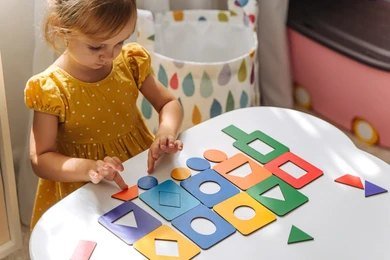
- Geometric Cabinet Presentation Tray: This tray help the child to determine different shapes and thus he recognizes shapes, sizes and foster his hand-eye coordination and fine motor skills. It often enhances the child’s geometric vocabulary and their properties.
Conclusion:
The development of sensory and motor skills in early childhood education lays the great importance for a child’s holistic growth, learning, and independence. These skills not only play a role in daily activities like walking, writing, or self-care but also help the child in building focus, problem-solving abilities, and social interaction. Children who learn under the Montessori approach become more confident and competent throughout their entire learning process as they are aware of critical and challenging situation. Therefore, guardians and educators must prioritize activities that nourish both sensory and motor abilities by enrolling the kids in good Montessori school nearby, ensuring children are well-prepared to meet the challenges of tomorrow.
Related Reads
- Custom Fitness App Development: Build the Fitness App Your Users Actually Want
- Global Transplant Diagnostics Market: Trends, Growth, and Future Outlook (2024-2032)
- Why Italian Cypress Trees Are Popular In Mediterranean Landscapes
- Rubber Masterbatch Manufacturers In Gujarat – Leading the Industry with Innovation
- Banquet Near by Me – Discover Perfect Venues for Memorable Celebrations
- Chrome Hearts Hoodie Chrome Hearts Considered Luxury Fashion